“These are the cues for an exhibition; an exhibition tuned in to the minor keys; an exhibition that invites listening to the persistent signals of earth and life, connecting to soul frequencies. If, in music, the minor keys are often associated with strangeness, melancholy and sorrow, here their joy, solace, hope, and transcendence manifest as well.”
— Koyo Kouoh, In Minor Keys
Drawing on Koyo Kouoh’s curatorial vision for the 2026 Venice Biennale, Soul Frequencies celebrates jazz, blues, soul, and Black musics more broadly as spaces of circulation—sites where sound becomes a vector of memory, resistance, and liberation. More than a repertoire, they constitute a way of being in the world: a shared frequency capable of connecting bodies, histories, and imaginaries. Bringing together nine contemporary artists from different regions of Africa and its diasporas, the exhibition invites viewers to inhabit these frequencies and experience their resonances.
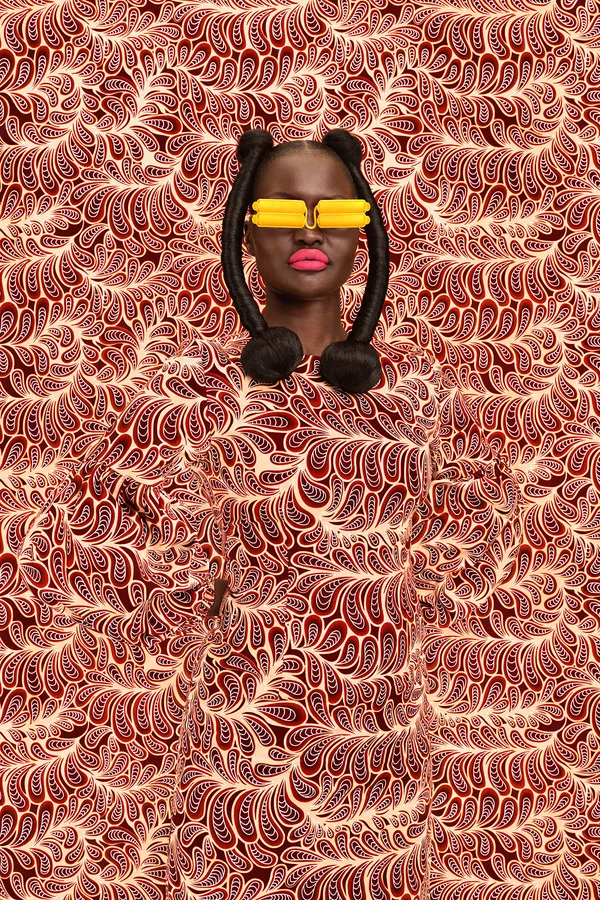
Music first appears here as a living material, an archive in motion. In the work of Modou Dieng Yacine, archival photographs of dances in Saint-Louis are reactivated through a vivid palette he describes as “colonial,” replaying the ambivalence of an imposed visual heritage shaped by a fantasized exoticism, while dance becomes a space of liberation. Responding to this pulse, in resonance, Shourouk Rhaiem transforms record sleeves—from Nina Simone to Marvin Gaye—into intimate refuges, adorned with crystals, revealing the emotional and projective charge of these objects. From this sonic material emerge voices, sometimes silenced—those of women in majesty brought forward by Thandiwe Muriu. Paired with African proverbs, her images affirm the unifying role of women in Kenyan society and underscore the importance of transmitting knowledge in a world moving at increasing speed.
This speech, turned into memory, naturally extends into a relationship with ancestry, inherited histories, and the invisible. The sculptures of Mehdi-Georges Lahlou, between totem and self-portrait, unfold through the recurring metaphor of the palm tree narratives of filiation, migration, and resilience: the artist’s body becomes the structural spine of a date palm from which fruits emerge, as signs of continuity. In the work of Christa David, spirituality takes form in cut-out figures in prayer, engaged in an act of reconciliation and care, as if the image itself could mend fractures between the human and the world. In Hyacinthe Ouattara’s sculptures, composed of worn fabrics and used clothing, this reflection continues: they embody a living memory, where a red, almost blood-like thread binds the forms together as vital energy, connecting lives across time.
The exhibition then unfolds into a reflection on the collective, where creation becomes a shared space. The project NOIRES by Roxane Mbanga, developed between Guadeloupe and Côte d’Ivoire in search of her origins, brings together drawings placed on handwoven batik textiles made in collaboration with other women, through transmitted gestures and craft traditions. This attention to connection resonates in the works of Joana Choumali, where scenes of everyday life—a mother guiding her child, men gathered through labor—are embroidered with golden thread and bathed in a soft light. The care invested in these images extends the artist’s practice, as she photographs the world each morning at first light to reveal its fragile beauty.
In their extension, Adler Guerrier’s photographs, capturing the vegetation of Miami’s urban gardens, shift this idea of community toward an expanded temporality: enhanced with painted color forms named after other geographies (Gris Bamako, Rose Passada), they suggest discreet presences, like traces of souls or markers of community. In the heart of the city, the garden becomes a site of projection and patience—a space where something is cultivated beyond the human scale, a promise of continuity, perhaps a dream of Eden, in any case a form of transcendence.
Through these practices, Soul Frequencies sketches a sensitive cartography in which music acts as a principle of circulation and persists as vibration. From one gesture to another, from one image to the next, a shared space emerges where everyday life—sometimes tested—quietly opens onto elsewhere. Perhaps this is where the strength of this gathering of artists lies: in its ability to bring forth, at the very heart of the real, forms of displacement—escapes, breaths—where art, like music, reveals what is common to us and opens up the possibility of making community.
-
 Mehdi-Georges Lahlou, De la Conférence des Palmiers, totem dattier (From the Palm Conference: Date Palm Totem), 2024
 -
Mehdi-Georges Lahlou, Créature pour chaman ou autoportrait à la cannelle, 2018
-
Joana Choumali, Good Omen, 2025
-
Joana Choumali, Winning your life back, 2025
-
Modou Dieng Yacine, Bal a Saint-Louis #1, 2024
-
Hyacinthe Ouattara, Constellation organique (Organic Constellation), 2025
-
Hyacinthe Ouattara, La mémoire du monde (Memory of the World), 2024
-
Christa David, Mark what is yours now, always, 2023
-
Shourouk Rhaiem, Vynil Bangles Walk Like an Egyptian, 2025
-
Thandiwe Muriu, A Constellation of Power, 2025
-
Thandiwe Muriu, Rhythms of Renewal, 2026
-
Adler Guerrier, Untitled (Maynada Mangoes), 2017